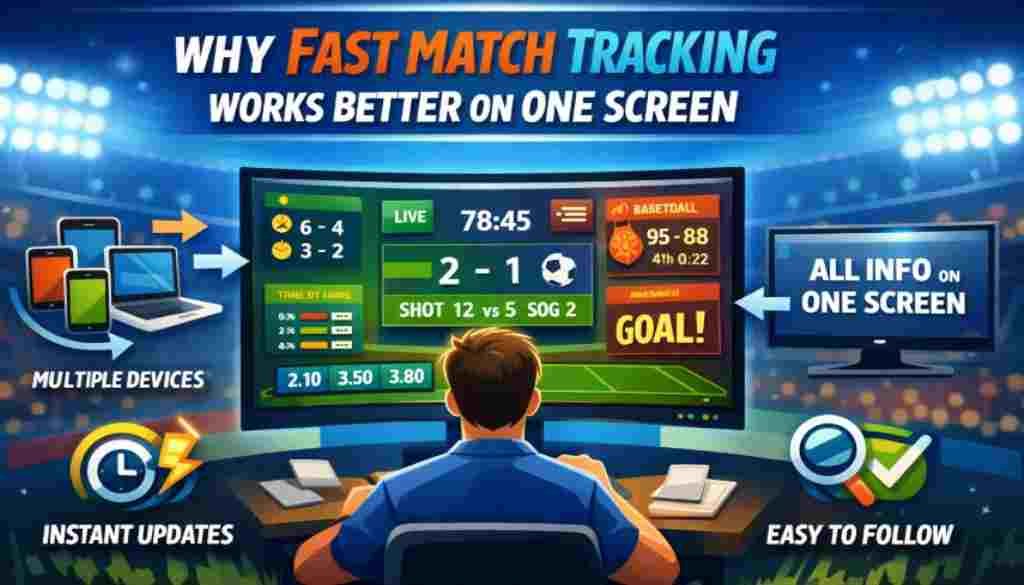
Why Fast Match Tracking Works Better on One Screen
TeckJB writes for readers who like digital tools explained in a practical way. The website identifies itself as a platform for applications, gadgets, technological trends, and web utilities, and focuses on the readability of cricket scores, game dynamics, and summaries rather than elaborate commentary on the sport. That editorial style makes this topic a clean fit. A live cricket page becomes interesting here when it is treated as a mobile utility instead of a fan page alone.
For many users, the real question is not how to watch every ball. The real question is how to check the state of a match quickly, make sense of it at once, and move on without opening five tabs. That is exactly the kind of everyday digital behavior a TeckJB audience already understands.
The First Check Should Answer the Main Question
A good match page earns trust in the first few seconds. That is where a cricket live match site starts feeling less like a sports extra and more like a usable mobile tool. The live page connected to this brief shows league groupings, innings labels, and short time windows such as 1H, 3H, 12H, and 24H, with a winner field visible near the match view. That structure matters because most people do not arrive looking for every detail at once.
They want to know which game is active, what stage it has reached, and whether the balance has shifted. If a page answers those three questions fast, the user stays oriented. If it does not, the user starts bouncing between search results, social feeds, and separate score pages. On a phone, that difference feels even bigger because attention is already split.
Live Tracking Feels Better When the Layout Does Less
Many sports pages lose readers by trying to display too much at once. A cleaner live view usually works better because the screen has one job first – make the present moment readable. TeckJB’s own match scorecard posts show a similar instinct. They focus on batting, bowling, match flow, turning points, and simplified tables so readers can understand what happened without digging through clutter. A live page follows the same logic from the other direction.
Instead of summarizing after the result, it keeps the current state visible while the match is still moving. That makes a compact layout more useful than a crowded one. A user checking during work, travel, or a short break does not need a dramatic interface. A lighter screen with the right order of information usually wins because it shortens the path between opening the page and knowing what changed.
Time Filters Change How a Phone User Reads the Match
The more functional design elements in the live page include the short time windows available for filtering. Filters such as the visible 1H, 3H, 12H, and 24H are more than decorative and enable users to filter down into the most recent content quickly. This is important since mobile viewing tends to be non-linear. Users will check on the page before and after work, as well as during their lunch break. In the absence of time-based filtering, the live page can begin to feel more bloated than necessary.
In this context, the screen is made more user-friendly by eliminating the need for the individual to establish a new context every time they open the window, since the structure allows them to easily return to the page. Such design elements have been seen repeatedly among readers in technology literature.
One Screen Usually Beats Tab Chaos
The biggest practical win from a page like this is that it reduces tab chaos. A lot of fans still move between search, short clips, score widgets, and chat updates just to understand one match. That pattern wastes time and drains focus. A more compact live page can reduce that friction because league, innings, and result cues are gathered in one place instead of being scattered across several windows. For TeckJB readers, this is a familiar digital lesson.
The site covers tools that work best when they cut extra steps rather than adding more polish on top of a messy process. A live cricket page follows that same rule when it lets the user check the match in one glance and return to other tasks. On a phone, that kind of efficiency matters more than decorative extras because the screen is small and every unnecessary tap feels larger than it would on a desktop.
When Live Pages Beat Full Scorecards
A full scorecard still has value, especially after the match, when a reader wants bowling figures, batting breakdowns, and a clearer picture of how the result was built. TeckJB already leans into that format through scorecard articles that highlight runs, wickets, partnerships, and turning points in a simplified way. Live pages serve a different moment. They are better when the user wants awareness before analysis. That difference matters because many people reach for the wrong format at the wrong time.
During the match, most checks are short and practical. After the match, the appetite for detail gets larger. The live page tied to this brief fits the first habit well because it keeps the state of play visible without demanding a long read. That makes it a smart companion to scorecard-style reading rather than a replacement for it. Each format works better when its job stays clear.
The Better Habit Is Short Checks With Better Context
The strongest digital tools usually fit into the day without asking the day to stop. That is the real appeal of this kind of live cricket page for a TeckJB audience. It gives enough context to support quick checks, keeps current match information grouped in a usable order, and makes return visits easier through short time filters and visible innings markers. None of that needs loud promotion to make sense.
The value appears in ordinary use, especially for mobile readers who want the state of a match without turning every update into a separate search task. For a site that already writes about apps, gadgets, scorecards, and digital habits in a straightforward tone, this is the angle that lands best. A live page is most useful when it respects time, keeps the screen readable, and lets the user leave with the answer already in hand.